WRWC Highlights Climate Resilience at Rhode Island Green Bond Kickoff
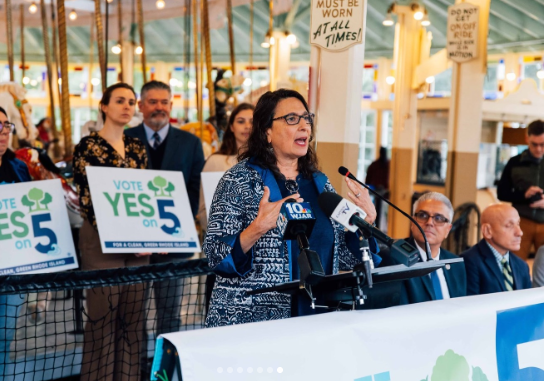
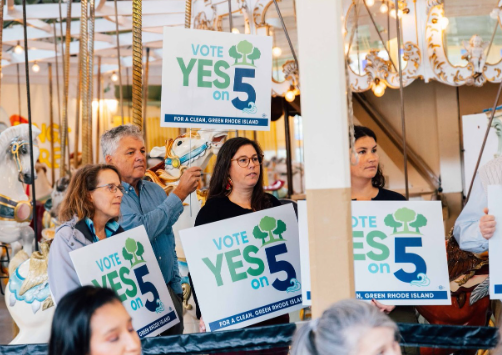
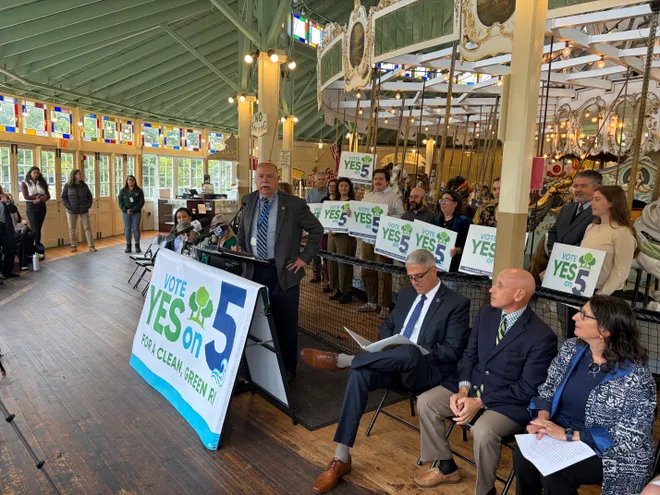
On Monday, September 28, environmental organizations, municipal leaders, and state officials gathered at the Crescent Park Carousel in East Providence to kick off the public campaign around Rhode Island’s 2026 Green Economy Bond, Question 5.
The $55 million bond will appear on the statewide ballot on November 3 and would direct funding toward climate resilience, clean water and watershed restoration, state parks, open space and farmland preservation, brownfield cleanup, local recreation, and marine infrastructure. The largest portion, $25 million, would support the Resilient Rhody Infrastructure Fund for projects addressing flooding, coastal erosion, stormwater, and other climate-related challenges.
WRWC Executive Director Alicia J. Lehrer joined leaders at the kickoff to speak about what investments like these can mean on the ground, highlighting a major project now taking shape along the Woonasquatucket River in Smithfield.
Bringing Climate Resilience to Esmond Village
WRWC was recently awarded $350,000 through the Climate Resilience Fund for the Esmond Village Linear Natural Infrastructure Park, a project being developed in partnership with the Town of Smithfield and the Rhode Island Department of Transportation. The Climate Resilience Fund is supported by Rhode Island’s voter-approved 2024 Green Bond.
The $350,000 award will support green infrastructure improvements within Esmond Park, using nature-based stormwater practices to capture and infiltrate runoff before it reaches the Woonasquatucket River. The work is intended to reduce flooding, improve water quality, and strengthen climate resilience in Esmond Village and downstream communities.
The stormwater work is one piece of a much larger effort that will also bring the Woonasquatucket River Greenway into Smithfield for the first time, extending it from the Johnston town line through Esmond Village.
For Lehrer, the project demonstrates how climate resilience investments can accomplish several goals at once.
In addition to managing polluted stormwater and reducing flooding, the larger project is designed to help revitalize the commercial center of Esmond Village, create new recreational opportunities, improve pedestrian and cyclist safety, and give residents greater access to the Woonasquatucket River and surrounding natural spaces.
The location makes that opportunity particularly significant. The nearby East Smithfield Neighborhood Center recently underwent a $5 million renovation, creating a community-centered setting where new green infrastructure can be visible, accessible, and educational.
Local Investment That Unlocks Larger Projects
A major focus of Lehrer’s remarks was not simply the amount Rhode Island invests through Green Bonds, but what that funding can make possible.
More than $8 million has already been secured for the larger Esmond project, with another $5 million pending. More than half of that funding comes from federal sources that require non-federal matching funds.
That makes state investment an important piece of assembling the larger funding package.
“The Green Bond is so important because state investment helps leverage so much other investment,” Lehrer said. “Without the matching opportunity the Green Bond provides, we would not be able to leverage those funds to make such significant improvements in Rhode Island.”
The Esmond project brings together the Town of Smithfield, RIDEM, RIDOT, Rhode Island’s congressional delegation, the USDA Natural Resources Conservation Service, the U.S. Environmental Protection Agency, Restore America’s Estuaries’ Southeast New England Program, and WRWC.
It will also mark WRWC’s first major project in Smithfield, building on decades of restoration, recreation, green infrastructure, and community investment throughout the Woonasquatucket River watershed.
Building Resilience Across the Watershed
The work in Esmond is also part of a much larger challenge.
WRWC has worked for years on watershed-wide strategies to reduce flooding and better manage stormwater. A project that captures runoff in Smithfield can provide benefits at the immediate site while also contributing to efforts to reduce impacts farther downstream.
That watershed approach is increasingly important as Rhode Island experiences the effects of heavier rainfall, flooding, erosion, and more intense storms. DEM cited those growing risks when announcing more than $2 million in Climate Resilience Fund awards to eight projects across the state, including WRWC’s Esmond project.
Lehrer closed her remarks by looking beyond any single project or funding cycle.
“As storms like the one we are experiencing today are becoming more frequent with more rain, storm surge, flooding and related problems, the Green Bond is going to need more support and investment than ever if we are to be prepared and resilient as a state.”
Her final message was simple: “We need to think more boldly in the future. We owe it to future generations of Rhode Islanders.”
The 2026 Green Economy Bond will appear as Question 5 on Rhode Island’s November 3, 2026 statewide ballot. Rhode Islanders can review the bond, its proposed allocations, and official voting information through the Rhode Island Department of Environmental Management and Rhode Island Department of State.